
Nepal Floods: Trishuli River Rises 9 Metres In 30 Minutes, Experts Probe Cause Of Devastating Flash Flood
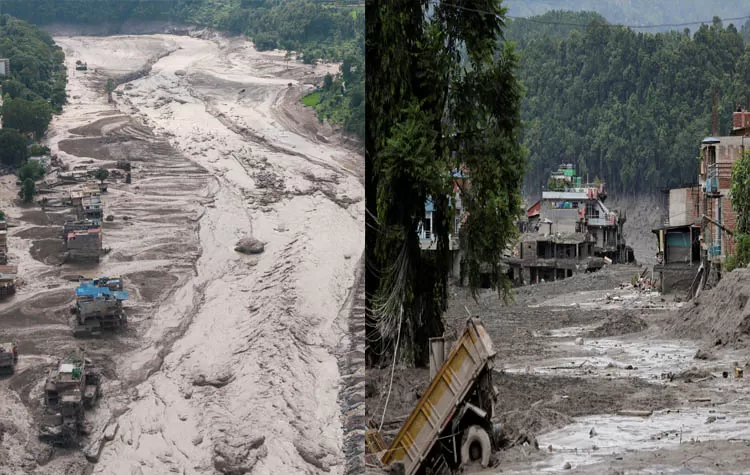
The catastrophic flash flood in the Himalayas triggered by record-breaking rain has led to several questions after it became evident that the water level in Trishuli River near Galchhi surged by as much as 9 m within half an hour.
The flash flood devastated the areas along the Bhote Koshi and Trishuli rivers as the water pulled by the force of the current carried away large volumes of water, muck, sand, rock, and boulders.
Trishuli River Water Level Rose 9 Metres
“The water level (in the Trishuli River) climbed by nearly 9 meters in Galchhi in half an hour,” said the initial report. It also noted that the level (in Malekhu) rose by 7 m within the same timeframe.
Both jumps hint that the flood was not a typical monsoon surge but rather a geomorphological response to a sudden input of huge volumes of water and sediment from upstream.
Some of the water-monitoring stations along the Trishuli River were damaged or swept away during the disaster. At the same time, Galchhi hydrological station survived the flood and helped understand how high the surge actually was.
What Triggered the Nepal Flash Flood?
According to preliminary information, the catastrophe was probably triggered by an ice-rock avalanche originating in the high Himalayas.
It is supposed that the flow of ice and rock entered the Lende Khola, which is a tributary of the Bhote Koshi River. The impacted water, in turn, triggered the enormous flood that had a debris-laden current carrying boulders.
The satellite imagery verified that the event was related to the detachment of an extensive part of the glacier located at an altitude of 5,200 meters above sea level and slipped down on a slope of 1,200 m into the valley. Nevertheless, the detailed mechanism of this catastrophe remains under the investigation.
The Threat of the Second Surge
- Researchers are also discussing the possibility of the second flood wave that might occur when the obstruction dam, which is formed by the debris of the avalanche, releases the water.
- Such a dam can be unstable, suddenly give way, and release a surge of water downstream.
- The experts are currently analyzing the characteristics of this potential obstruction to predict whether such a scenario is possible.
- Moreover, it is also difficult to say for sure whether the earthquake caused the avalanche to occur.
- The earthquake’s seismological data are under investigation as researchers are trying to understand whether it actually triggered the avalanche in the Nepalese Himalayas. So far, no connection has been confirmed, but it is still not ruled out. This issue, as well as the connection between the flood and the earthquake, requires further investigations.
Nepal Floods Trigger Massive Destruction
The flash flood triggered by the avalanche devastated the area along the courses of the Rasuwa, Nuwakot, and Dhading rivers — the mountainous region of Nepal. The disaster impacted infrastructure, housing, road, and bridge networks.
The hydropower stations and routes in the region were closed due to the disaster to ensure the safety of pedestrians. The area is a crucial gateway for the Tibetan Plateau, where many tourists and pilgrims heading to Mount Kailash and the lake begin their journey. Reuters reported that the flash flood triggered a large-scale search and rescue operation, where the teams try to reach out to the isolated regions to assist those affected by the catastrophe. It is reported that hundreds of people are missing — on both sides of the border.
The main concern for researchers dealing with this disaster is the suddenness of the flood.
The fact that the water level in the Trishuli River near Galchhi surged by 9 m within half an hour demonstrates how little time people have to react to hazards and threats in the high mountains. Once initiated, such a surge can sweep everything away in its path. Thus, there will be little time to escape if a catastrophe of this kind occurs in other regions.
Growing Concern for High-Mountainous Hazards in Himalayas
- The tragedy once again drew the attention of scientists to the high-mountain hazards in the Himalayas.
- The glacial treads, avalanches, landslides, ice lakes, and floods in this region can lead to devastating disasters.
- The rapid change in climatic conditions in this region has led to the critical destabilization of glaciers, slopes, and snowfields. Researchers are especially concerned about the dangerous combination of glacial-hazard triggers in the high mountains of the Himalayas. Reuters noted that right now, it is impossible to say with a high degree of certainty whether the unusual heat and cold contributed to the disaster.
- Nevertheless, the authorities and rescuers are continuously trying to help the affected population and conduct search and rescue operations.
- Meanwhile, helicopters try to reach the sites accessible only on foot.
- Monitors also watch the rivers to see if more water will come as a result of an additional surge.
- The flash flood in Nepal’s Himalayas has led to thousands of people being trapped on both sides of the border. The sudden rise of the water level by almost 9 m in the Trishuli River at Galchi demonstrates how fast disasters in high mountains can develop. Investigators are trying to understand what exactly triggered this particular disaster. The flash flood is a sign of how little time people have to react to various dangers in high mountains.
Tags Cloud