
Anthropic Employee Claims To Have Solved 167-Year-Old Riemann Hypothesis Using AI
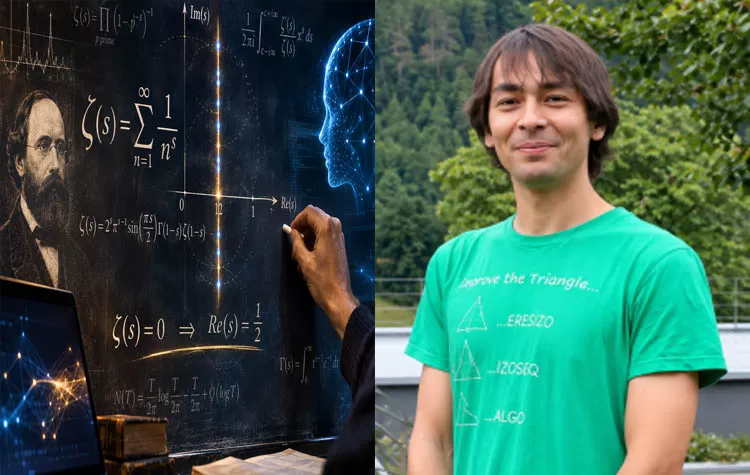
An alleged breakthrough in mathematics has caused worldwide excitement, as a mathematician at Anthropic has apparently solved the Riemann Hypothesis with the support of the firm’s AI chatbot, Claude. If proven true, this may be one of the biggest mathematical breakthroughs in recent times.
Alleged Mathematical Breakthrough in History
Levent Alpöge, a mathematician employed by Anthropic, has announced that with the help of Anthropic’s AI Claude he has found an apparent solution to the Riemann Hypothesis. In a 4-page summary, Alpöge discusses in detail how AI was heavily involved in creating this solution.
Alpöge stated that Claude provided very valuable insight during his research, and helped make progress in proving the hypothesis. The amount of mathematics generated in this research collaboration demonstrates the increasing power of AIs in complex research fields.
Understanding the Riemann Hypothesis
The Riemann Hypothesis is one of the most important unsolved problems in mathematics. It was first proposed in 1859 by German mathematician Bernhard Riemann. The hypothesis concerns distribution in prime numbers.
A prime number is a number which is divisible only by itself and 1. The Riemann Hypothesis suggests that the non-trivial zeros of the Riemann zeta function will all lie on a particular vertical line in the complex plane.
Despite this problem having been studied by mathematicians for over one and a half centuries, a widely accepted proof or disproof has not yet been found.
Role of AI in Breakthrough
This breakthrough demonstrates the increasing use of AI in mathematical research. Alpöge is alleged to have created a complex mathematical proof with the support of Anthropic’s Claude AI. The proof was apparently translated into a formalised proof, using programming language Lean.
The formalisation of this proof contains approximately 17 million lines of code in Lean, and over 250,000 pages of mathematics were generated in this research collaboration. This highlights just how complex the solution to the Riemann Hypothesis appears to be.
This has caused discussion as to how powerful AI systems and machine learning, including automated mathematical reasoning, could be in creating scientific discoveries in the future.
$1 Million Millennium Prize Problem
- The Riemann Hypothesis is one of seven problems identified by the Clay Mathematics Institute in 2000, each with a prize of $1 million for an accepted solution.
- If Alpöge’s proof is verified by independent mathematicians and meets criteria set by the institute, it could qualify for this prestigious prize.
- However, at this point in time, it is important to highlight that merely announcing that an issue has been solved does not mean it has been solved. The proof must be thoroughly analysed by mathematicians before any recognition can be given.
Independent Verification Required
- Although this news has caused great excitement, leading mathematicians have stressed the importance of independent verification. As this proof is incredibly complex and long, experts in mathematics require enough time to properly understand the proofs concepts and check for any potential mistakes.
- As of now, the Riemann Hypothesis is still listed as unsolved on the Clay Mathematics Institute website. However, the President of the institute has stated that this could be a historic development, although it may take a long time for the mathematical community to fully understand and accept this proof.
- In conclusion, this breakthrough should be considered a significant development within mathematics at the moment, however it cannot be confirmed as a solution until further verification.
AI May Revolutionise Future Research in Science
This announcement has caused discussion once again about the future of science with AI. Complex AIs such as Anthropic Claude and other large language models are being looked into for solving complex mathematical problems, analysing research papers and supporting scientists. If Alpöge’s proof is verified, it may be a major step forward in using AI in mathematics. It could demonstrate how effectively humans and AI can work together to solve some of the most difficult intellectual challenges faced by humanity.
As mathematicians across the world await independent verification, this development is one of the most highly anticipated within AI and mathematics research.
Tags Cloud