
India Oil Crisis: Can Venezuela Replace Russian Crude As Trump Tightens Iran Sanctions?
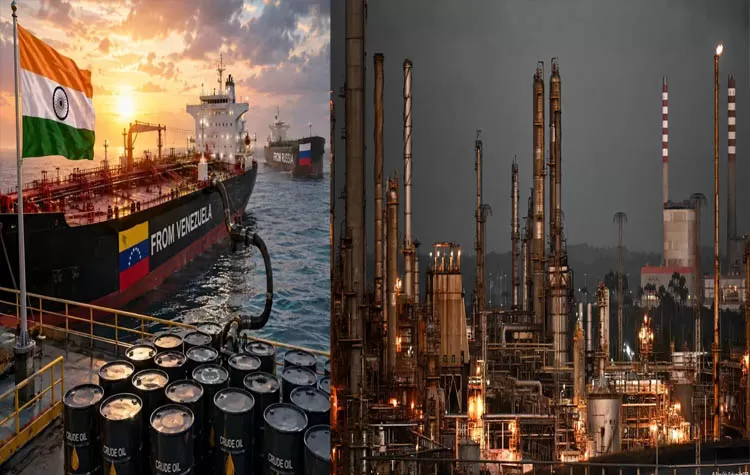
India’s Crude Oil Import: New Geopolitical Risk Emerges
India’s crude oil import profile is exposed to a new geopolitical risk as the U.S. escalates economic pressure on Iran and threatens to impose high tariffs on countries buying Russian oil.
The issue is especially pertinent to India, which scores over 90% of its crude oil needs from overseas. Any disruption to its suppliers can cause significant strain on the Indian oil import bill, as well as to its refining, pricing, and overall economy.
With geopolitical headwinds impacting oil supplies from the Middle East, Venezuela has emerged as a major supplier of crude to India.
But the critical question is, can Venezuelan oil replace Russian crude?
Probably not completely.
Why Russia’s Crude Is So Integral to India: Analysis
- Russia has become one of India’s most crucial suppliers of crude oil.
- Evidently, Russian crude holds a special appeal for India’s oil refiners. As per the latest figures, Russia supplies accounted for a record 50.83% of India’s total crude oil imports in July 2026, or 2.47 million barrels per day (bpd).
- The situation was catalyzed by Russia’s crude oil being particularly attractive to Indian buyers, as well as reduced supply capacity from the Middle East.
- Yet, there is a major drawback to this growing reliance on Russian oil, as the U.S. is set to impose 100% tariffs on countries buying Russian crude oil, creating an additional challenge for India, which has become deeply reliant on Russian crude imports.
Escalated Sanctions from the U.S. Further Complicate the Situation for India
The Russian oil dilemma is further exacerbated by another development, i.e., intensified U.S. sanctions against Iran.
The Trump administration has embarked on a campaign to cripple Iran’s petroleum trade by imposing sanctions on firms dealing with the Islamic Republic. Moreover, on August 25, 2026, the U.S. added four Indian entities to its sanctioned list, accusing them of supporting Iran’s petroleum and petrochemicals trade.
While India’s direct dependence on Iranian crude is limited, the situation could deteriorate for India in the context of soaring global oil prices.
Iran is a major oil producer, and its crude exports are vital to maintaining worldwide supply-demand dynamics. With further geopolitical tension, global oil prices are expected to rise, which would add to the burden of India’s oil import bill.
Venezuela Becomes a Major Supplier of Crude to India
- Meanwhile, there is no doubt that Venezuela has emerged as a critical supplier of crude to India.
- As per Kpler Research, as mentioned in recent reports, Venezuela’s exports to India soared through April-July 2026, averaging 220,000-380,000 bpd at various times. Thus, Venezuela has overtaken as one of India’s top suppliers of crude oil.
- Similarly, Latin American crude oil has also gained prominence in India’s import profile.
- Particularly, between April and July 2026, Latin American crude accounted for 12.7% of India’s total oil imports, as compared to 3.5% a year earlier. Meanwhile, the Middle East’s share dropped considerably during the same period.
- Crucially, it is necessary to understand that India is pursuing a policy of reducing its dependence on any particular supplier by relying on several sources.
Can Venezuelan Oil Come to the Rescue of India?
While Venezuela possesses massive oil reserves, there is a crucial caveat, viz. its limited production capacity.
As per estimates, Venezuela can provide about 1.2-1.3 million barrels of oil per day, whereas India’s Russian crude oil purchases regularly exceed 2 million barrels per day. Thus, it is highly unlikely that Venezuela can meet India’s needs in the context of Russian crude oil.
Industry analysts also believe that while India can buy several hundred thousand barrels per day from Venezuela, it will not be enough to bridge the gap created by a potential loss of Russian supplies.
While it may act as a partial substitute for Russian crude oil, Venezuelan oil is unlikely to be sufficient to fill the void.
Another Advantage of Venezuelan Crude: Heavy-Southern Oil
- One major advantage of Venezuelan crude is that it is heavy-sour crude oil.
- It is, indeed, true that many Indian oil refineries have the technological capability to process heavy-sour crude oil. Particularly, Indian oil refineries possess large-capacity processing units, allowing them to tackle challenging feedstocks. For instance, Reliance’s Jamnagar refinery is among the world’s most sophisticated oil-processing facilities.
- Thus, there is no doubt that Venezuela’s heavy-sour crude oil is an attractive proposition for India’s oil refiners.
- Additionally, it is noteworthy that Venezuelan crude can be sold at a significant discount to international oil benchmarks, providing additional scope for processing profit.
- Yet, there is a major impediment to Venezuela’s ability to meet India’s demand for oil, i.e., the long distance.
- With the Middle East and Russia being much closer to India, oil tankers carrying Venezuelan crude have to travel much farther, which makes it unviable despite its potential price advantage over other crudes.
India’s Oil Import Bill May Be Under Threat: Outlook
While the ability of Venezuela to satisfy India’s hunger for oil may be limited, the more pressing concern for India’s oil importers is the impact on global oil prices.
India imports more than 90% of its oil needs, making it especially vulnerable to any changes in world oil prices. Geopolitical tensions can lead to reduced supply from certain producers, causing prices to rise.
This, in turn, will lead to higher oil import bills for India, as well as higher refinery costs, putting additional pressure on the rupee and inflation, as well as higher prices for petrol and diesel in the country, which will have a cascading effect on transportation costs and other goods and services.
Furthermore, as per recent market analyses, Brent crude prices are expected to peak at around $100 per barrel later this year, should global geopolitical tensions persist.
India Is Looking to Other Suppliers Apart From Venezuela: Outlook
India is looking to other suppliers apart from Venezuela.
India’s refineries are exploring other suppliers, including those in Latin America, Africa, as well as the Middle East, to satisfy its growing appetite for crude oil. The latest trends in India’s oil imports suggest that the country is gradually moving away from its historical dependence on just a few oil-producing nations toward a more diverse set of suppliers.
As per the latest statistics, Russia’s share in India’s oil imports rose substantially, while that of the Middle East fell, with increased contributions from Latin American suppliers.
Thus, there is no doubt that India’s oil importers have taken a prudent step in reducing their dependence on any one supplier, as political and economic developments in any one country can wreak havoc on their oil import plans.
Why Can’t Venezuela Become a Major Supplier of Oil to India?
- Unfortunately, despite the government’s best efforts, there are several reasons why Venezuela is not poised to become a major supplier of oil to India:
- 1. Limited production capacity: Venezuela cannot ramp up production rapidly enough to meet the demand from India.
- 2. Demand from the U.S.: A considerable amount of Venezuela’s production is siphoned off to the U.S.
- 3. Long-distance travel: Tankers carrying Venezuelan crude have to travel long distances to reach India, as compared to other oil suppliers.
- 4. Infrastructure: India’s oil importers have to rely on existing infrastructure in Venezuela to facilitate oil exports.
- 5. Limited processing capability: Not all Indian oil refineries are equipped to process heavy-sour crude oil, which is characteristic of Venezuela’s oil exports.
Tags Cloud