
UPI Charges From October 15, 2026: New Merchant Payment Rules Explained
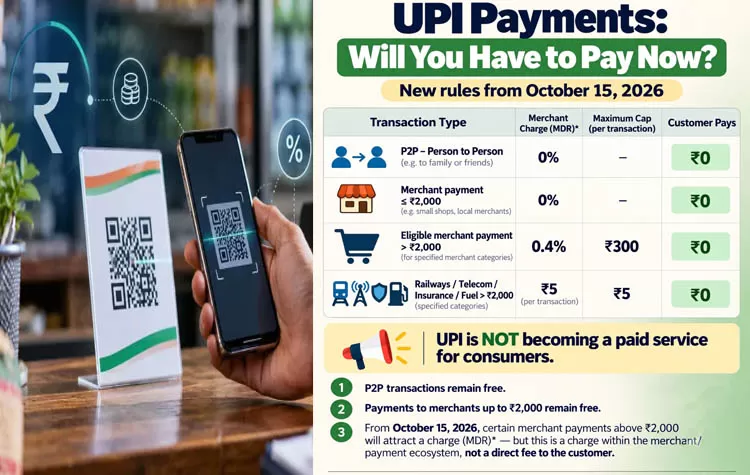
India's popular UPI system is set to introduce a new Merchant Discount Rate (MDR) for large payments by eligible merchants from October 15, 2026 . Under the new system proposed by the National Payments Corporation of India (NPCI), eligible Person-to-Merchant (P2M) UPI transactions of more than Rs 2,000 will be charged an MDR of 0.4%. Thus, businesses making large UPI payments will see a change in expense norms, whereas day-to-day UPI payments by ordinary people will remain free under the proposed framework.
What Is the New UPI Charge?
Eligible P2M UPI transactions of more than Rs 2,000 will be charged an MDR of 0.4%, according to the new UPI merchant payment guidelines.
For example, a customer paying Rs 10,000 to a merchant via UPI will be subjected to an MDR of Rs 40 (0.4% of Rs 10,000).
An MDR is a fee payable by a merchant to a payment aggregator or bank for processing a digital payment. It essentially constitutes a transaction fee indirectly borne by the merchant since it is not a direct charge imposed on the consumer. As per the reports, under the proposed system, either the banks or the payment aggregators would bear this MDR, and not the customers.
When Will the New UPI MDR Apply?
The new UPI merchant charges will apply from October 15, 2026 .
This will give banks, payment aggregators, fintech firms, and other market entities adequate time to reconfigure their systems and billing mechanisms.
Will UPI Payments of Up to Rs 2,000 Be Free?
UPI payments up to Rs 2,000 will continue to be free under the new UPI guidelines.
P2P UPI transactions will also remain free under the new rules. In other words, customers making small-value payments to other individuals or entities will not be subjected to any MDR under the new system.
What Will Happen to Payments Exceeding Rs 2,000?
Standard eligible merchant transactions of more than Rs 2,000 will be subjected to a 0.4% MDR under the new system. The reports add that an MDR of up to Rs 300 will apply to eligible payments of Rs 75,000 and above.
In other words, the MDR applicable to large-value UPI payments will be capped at 0.4% and Rs 300, respectively.
Illustration of New UPI MDR
UPI Merchant Payment Amount 0.4% MDR
- Rs 2,000 Nil
- Rs 5,000 Rs 20
- Rs 10,000 Rs 40
- Rs 25,000 Rs 100
- Rs 50,000 Rs 200
- Rs 75,000 Rs 300
- Rs 1,00,000 Rs 300 (capped)
The examples given above only serve to illustrate the standard 0.4% MDR and the Rs 300 cap, per the reports. Note that certain sectors are subjected to a separate MDR regime.
Rs 5 Flat Charge for Certain Sectors
Eligible P2M payments in certain sectors will be subjected to a Rs 5 flat MDR, as highlighted by the reports.
According to the findings, the sectors subjected to a Rs 5 flat MDR (instead of the standard 0.4% or Rs 300 cap) include railways, telecom, insurance, and fuel. In other words, eligible payments to entities in these sectors will be subjected to a Rs 5 flat MDR if the payment value exceeds Rs 2,000.
Will Customers Be Charged Extra for UPI Payments?
The reports highlight that the UPI charges proposed by NPCI are essentially a merchant-level fee. In other words, eligible customers will not be directly charged any extra fees for making UPI payments under the new system. However, the merchants in question may indirectly bear some or all of the MDR as an expense. Notably, the government has stated that small-value UPI transactions and P2P payments will remain free under the new framework.
Why Is UPI Introducing MDR Charges?
UPI has become one of India's most widely used digital payment methods, and the system processes billions of transactions every month. The proposed UPI MDR changes are poised to benefit the various stakeholders involved and serve to promote India's digital economy.
UPI processed around 24 billion transactions worth $311 billion in August 2026, thus highlighting the scale and quantum of India's digital payments ecosystem.
Who Will Be Impacted by the New UPI Charges?
Eligible businesses making large P2M payments via UPI will be directly impacted by the new MDR guidelines. The businesses in question include:
- Retail stores
- Large-scale merchants
- Restaurants
- Service providers
- Online businesses
- High-value retailers
- Entities processing large QR payments
In other words, businesses making large-value UPI payments will be subjected to the new MDR charges proposed by NPCI. However, note that small-value UPI transactions will continue to be free under the new system. Similarly, P2P UPI payments will also remain free under the proposed framework.
What Does the New UPI MDR Mean for Small Merchants?
The reports highlight that small-value businesses making UPI payments using QR codes will also be protected under the new framework. For instance, the MDR will not apply to businesses earning less than Rs 1 lakh per month through QR payments. Similarly, UPI QR payments by customers in rural and semi-urban areas will also be free under the new system, as per the reports.
Essentially, this distinction is important since there are millions of small-value businesses and street-level vendors using UPI in India's hinterlands.
UPI Remains Free for Day-to-Day Low-Value Payments
The most important takeaway from the new UPI charges is that UPI is definitely not becoming a paid payment method for India's common consumers. The new MDR framework essentially only targets large-value merchant payments. In other words, UPI charges for small-value payments by ordinary consumers will continue to be free under the new regulations.
Consumers making regular payments for groceries, food items, and other small-value transactions can, therefore, continue to use UPI as a free payment method, barring any changes to the merchant-level MDR.
What Should Merchants Do Before October 15?
Merchants making UPI payments should, therefore, understand the new UPI charges and associated implications well in advance of the proposed October 15 deadline. In particular, merchants should:
- Review the updated MDR guidelines issued by their respective banks or payment aggregators.
- Understand whether they fall under the standard or special MDR regime, as applicable to their business.
- Review their accounting, banking, and reconciliation procedures.
- Monitor their settlement statements after October 15.
- Understand whether they are eligible for any QR code-based MDR exemptions.
- Avoid proposing any separate UPI charges to their customers.
UPI New Payment Rules – At a Glance
Effective October 15, 2026
- MDR for eligible P2M UPI payments of more than Rs 2,000: 0.4%
- UPI payments of up to Rs 2,000: No MDR
- P2P UPI payments: Always free
- MDR for eligible P2M UPI payments of Rs 75,000 and above: Up to Rs 300
- MDR for certain sectors: Rs 5 flat charge for eligible payments
- Who bears the MDR cost? Merchants
- Why the UPI charges? To ensure sustainability of the digital payments ecosystem
Tags Cloud