
Elon Musk Targets Mukesh Ambani Over Starlink India Launch: What Is The Controversy?
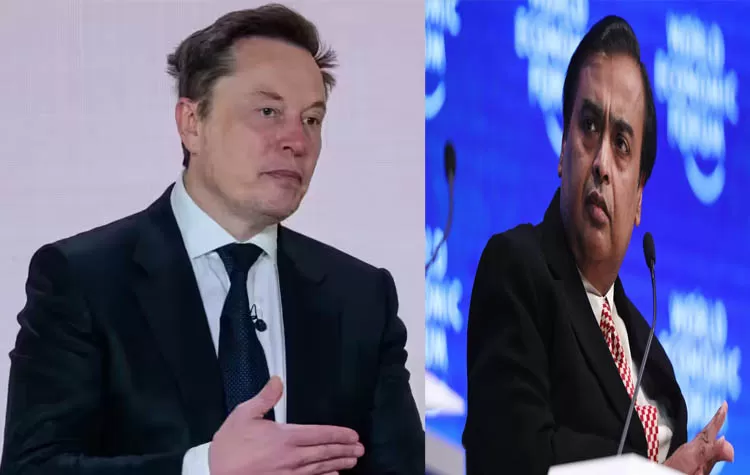
The Elon Musk and Mukesh Ambani controversy has escalated as SpaceX's Starlink satellite internet service awaits approval to commence commercial operations in India. Elon Musk has criticised India's telecom market and accused Reliance Industries chairman Mukesh Ambani of attempting to stifle competition. The dispute has sparked a heated debate about India's satellite internet regulations, telecom competition and the future of high-speed internet connectivity in rural areas.
Why Did Elon Musk Target Mukesh Ambani?
The Elon Musk and Mukesh Ambani controversy intensified after Elon Musk made allegations on social media platform X about Mukesh Ambani's influence in India's telecom market. Musk accused India's richest man of trying to establish a permanent monopoly over the country's internet sector and called him the "real boss of India".
Musk claimed that Starlink would bring internet connectivity to India's unserved and underserved communities. He cited the benefits of satellite internet for educational institutions, enterprises and emergency response services.
Despite his allegations, Musk's accusations against Ambani have not been proven to be true and the Indian government has denied allegations that it was blocking Starlink to favour domestic players.
Why Has Starlink Not Launched in India Yet?
News about Starlink India has garnered widespread attention as the company has sought to enter the competitive Indian telecom market for quite some time now. Even though Starlink has received key regulatory approvals, it needs to comply with the required security protocols and spectrum-related regulations before it can commence commercial operations in India.
Like any other satellite-based communication system, Starlink India requires authorisation to use specific portions of the radio-frequency spectrum to communicate with its satellites for providing internet services to its customers. In addition, governments impose certain security and operational requirements on organisations that operate satellite communication systems.
Why Is the Indian Government Blocking Starlink?
The Indian government has denied allegations that it has been obstructing the entry of Starlink in the country to shield local telecom operators from competition.
The government has repeatedly asserted that the clearance process for Starlink is appropriate and there is no discrimination against the company.
It has also been reported that Starlink India, Reliance Jio and Bharti Airtel are at a similar stage in the process of obtaining spectrum authorisation and security clearances from the government.
Starlink Vs Reliance Jio and Airtel: Who Will Benefit?
Starlink vs Jio vs Airtel is shaping up as an extremely compelling debate as more and more Indians demand better internet connectivity. Reliance Jio and Bharti Airtel are major telecom operators in India and Starlink's entry into the market will create a healthy competition between these players.
Traditional broadband and mobile network operators typically rely on fibre-optic cables or cellular towers to provide internet connectivity to their customers. On the other hand, Starlink provides satellite-based broadband internet services that do not require any physical infrastructure.
Starlink's satellite-based solution can be particularly helpful in rural areas, hilly terrains, islands and other inaccessible regions where laying fibre-optic cables or erecting mobile towers may not be viable options.
Interestingly, Reliance Jio and Bharti Airtel have signed an agreement with SpaceX to facilitate the distribution of Starlink in India even as they compete with the satellite internet provider.
Can Starlink Satellite Internet Help India?
- Satellite internet can be helpful for connecting India's unserved and underserved populations. Starlink's satellite-based broadband solutions can provide affordable and reliable internet services to rural and remote households.
- Improved broadband penetration in these regions can catalyse the adoption of online education, telemedicine and digital banking in India. In addition, small-scale businesses can leverage the power of the internet to scale their operations and sell their products online.
- Moreover, satellite internet can be critical for disaster management as it can provide communication support during and after a natural calamity when conventional communication infrastructure may be damaged.
- However, Starlink's ability to realise its vision depends on whether it can overcome the challenges in the Indian market and set up the infrastructure to provide these services.
What Does the Starlink Controversy Mean for Indian Telecom Companies?
The Starlink controversy reflects the growing competition in India's telecom sector that will have positive implications for consumers. While traditional telecom operators continue to invest in improving broadband infrastructure, the entry of a new competitor will force them to innovate and provide better value for money.
Nevertheless, the competition between Starlink, Reliance Jio and Bharti Airtel will play out on a different spectrum as satellite internet players have unique requirements with regards to spectrum authorisation, security clearances and infrastructure setup. Apart from telecom operators, this competition will also impact technology players, financial institutions and other stakeholders.
When Will Starlink Launch in India?
The launch of Starlink India depends on the company getting the required approvals, security clearances and spectrum authorizations to commence commercial operations in the country. Although the company has been making efforts to enter the Indian market for a while now, consumers should not start expecting Starlink broadband anytime soon.
Elon Musk's allegations against Indian businesspersons have created a lot of buzz around the Starlink controversy. However, the company will not be able to enter the Indian market merely by creating noise on social media.
Tags Cloud