
US Court Blocks Trump Administration’s New Visa Rule: Relief For International Students And Journalists
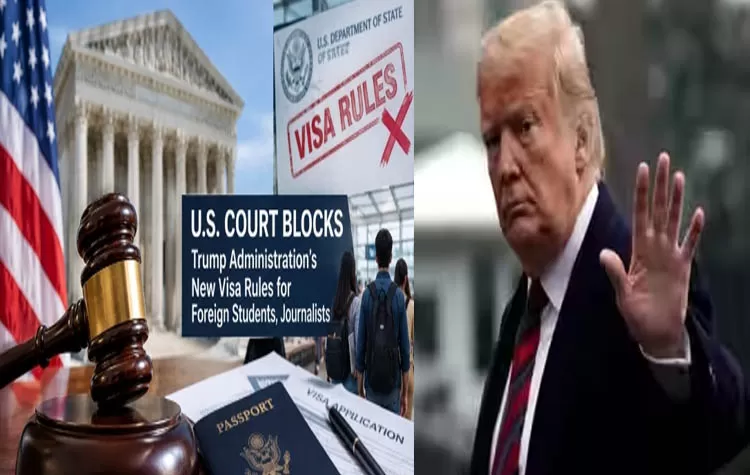
A federal court in the U.S. has declined a new Trump administration policy that would have imposed stricter regulations on the length of time that foreign students, journalists, and exchange visitors may stay in the country. The court ruling has created a setback to the administration’s immigration agenda.
The new rule, formulated by the Department of Homeland Security would have replaced what is known as the “duration of status” policy with time limits for specific categories of nonimmigrant visa holders.
What Did the New Visa Rule Propose?
The proposed regulation sought to impose a limit of four years for international students on F Visas and exchange visitors on J Visas and a period of 240 days for journalists on I Visas.
Currently, eligible foreign students and exchange visitors are allowed to stay as long as they maintain their status and meet the conditions for receiving a visa.
The administration’s rationale for the proposal was that limiting the duration of the visa would enhance homeland security, prevent visa misuse, and impose better monitoring of foreigners in the U.S.
Why Did the Court Decline the Rule?
The U.S. court in Boston, which was hearing the case, determined that the Department of Homeland Security had failed to provide sufficient justification for its policy. In addition, the court noted that the department did not explore alternative options that could have been used to address the concerns that prompted the proposal.
Furthermore, the court acknowledged that the current policy benefits American universities, international exchange programs, and the overall economy.
According to the report, the existing system has contributed to research advancements and the development of innovative ideas in the U.S. for the past two decades.
Impact on International Students
- The controversial proposal provoked widespread reactions from international students, especially those studying at American universities on undergraduate, graduate, and doctoral levels.
- Many such students would be negatively affected since the F1 visa, which allows students from outside the U.S. to study in the U.S., normally permits the visa holder to stay as long as it takes to finish their course of study.
- However, under the Trump administration’s proposals, these students would be subjected to extra administrative steps to renew their visas after the four-year limit for students was reached.
- Education analysts argue that the regulation would make American universities less attractive to international students and, thus, weaken the capacity of the institution to host elite global talent.
- The recent court ruling has offered a reprieve to these students and the universities as the ruling will ensure there is no abrupt implementation of this regulation.
What Does the Ruling Mean For Indian Students?
Indian students are among the largest number of international students studying at institutions across the U.S.
Therefore, the court ruling is a relief to them as it offers some assurance against the new Trump administration rules. Indian students enrolling at universities in the U.S. should however remember that the new rules will still apply unless this ruling is reversed, or when the revised regulations take effect.
As such, it is important that they comply with the regulations governing their status and are mindful of issues such as visa validity as well as other requirements for students on the F1 Visa program. Individuals considering studying in the U.S. should consult immigration authorities and their intended institution of higher learning on visa-related issues.
Broader Implications of The Court Ruling
The ruling is a setback to the Trump administration’s attempt to enact stricter immigration laws in the U.S. The U.S. court system has been instrumental in reviewing many proposals from the Trump administration, which are considered by the administration to be essential in protecting America’s national security.
It also demonstrates the concern of the U.S. judiciary system for the international education sector, as well as foreign students and journalists.
International students and journalists will now have a better chance to continue with their respective activities without experiencing a sudden policy shift in the visa policies that affect them. The Trump administration, meanwhile, will look to future court challenges and possible legislative revision to ensure that its immigration agenda is implemented.
Tags Cloud