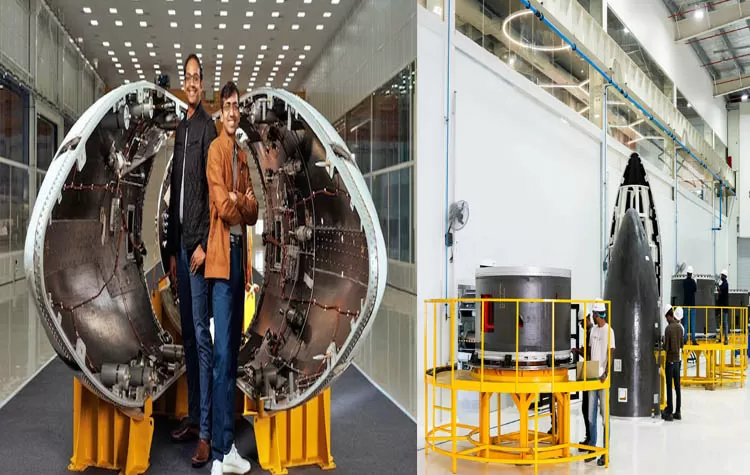
Skyroot Aerospace Becomes India’s First Private Space Unicorn
A Major Milestone for India’s Space Industry
- The Indian private space industry has completed its second main development stage. Skyroot Aerospace, which operates from Hyderabad, became the first Indian private space firm to reach Unicorn valuation status. A Unicorn is a startup which achieves a valuation of $1 billion.
- The company reached its current funding round after it received ₹565 crore which converts to about $60 million. The investment raised Skyroot's company valuation to approximately ₹10,360 crore which equals $1.1 billion.
- The company needs this development because it comes at a critical stage. Skyroot plans to launch its Vikram-1 rocket from Sriharikota within the next few weeks.
How Skyroot Aerospace Reached Unicorn Status
- Pawan Kumar Chandana and Naga Bharath Daka established Skyroot Aerospace in 2018 after they worked as ISRO scientists. The founders aimed to build affordable launch services for satellites and support the growing demand for space access.
- The company gained national attention in 2022 when it launched the Vikram-S rocket. Skyroot became the first private Indian company to achieve successful space launch of a rocket through that mission.
- Skyroot runs its rocket development and testing operations from its two sites which include Max-Q and Infinity campuses located in Hyderabad. The two facilities which operate together as one unit need 250000 square feet of space.
- Skyroot has experienced fast development during the last three years. The company secured $51 million during its Series B funding round held in 2023. The company valuation reached $519 million at that time. Its valuation has now more than doubled within three years.
Investors Back the Company’s Growth
- The latest funding round was led by Sherpalo Ventures and GIC, Singapore’s sovereign wealth fund.
- Multiple investors participated in the round together with BlackRock and Greenko founders and Arkam Ventures and Playbook Partners and the Sanghvi Family Office.
- Ram Shriram who founded Sherpalo Ventures will join Skyroot's Board of Directors through his investment because he currently serves as a board member at Alphabet Inc.
- Earlier this year BlackRock provided Skyroot with a debt facility that amounted to ₹100 crore.
- The strong participation from global investors reflects growing confidence in India’s private space industry and Skyroot’s long-term plans.
Vikram-1 Launch Moves Closer
- Skyroot currently conducts preparations to launch Vikram-1 which will become India's first privately developed orbital rocket.
- The rocket can transport satellites that weigh up to 350 kilograms to Earth's orbit. The company plans to launch it from Sriharikota within the next few weeks.
- Skyroot CEO Pawan Kumar Chandana stated that Vikram-1 mission will advance both Indian space exploration and global commercial space market development.
- The company stated that part of the newly raised funds will support commercial operations linked to this mission.
Plans for Future Rocket Development
- Skyroot develops Vikram-2 which uses advanced cryogenic technology for its upcoming rocket system.
- The new rocket will have the capability to transport payloads that weigh up to one ton. This would enable the company to conduct larger satellite missions while increasing its operational launch capacity.
- Company leaders believe that lower-cost launch systems and reliable technology will help India compete more strongly in the global space economy.
- Investors have also highlighted Skyroot’s focus on balancing performance and affordability in rocket launches.
Why This Achievement Matters for India
- Skyroot’s rise shows how quickly India’s private space ecosystem is developing. For many years, space activity in India was led mainly by government agencies such as ISRO. Private companies now play a larger role in launch services, satellite technology, and space manufacturing.
- The success of companies like Skyroot may encourage more investment in Indian space startups. It may also create new opportunities for engineers, researchers, and technology businesses.
- As global demand for satellite launches continues to grow, India’s private space firms could become important players in the international market.