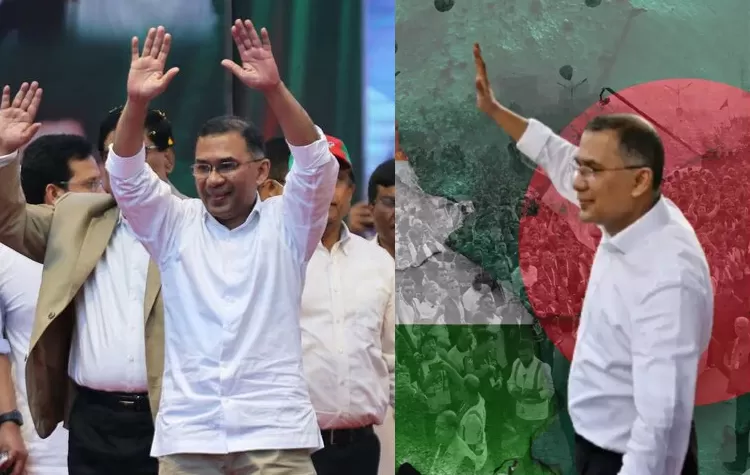
Political Shift In Bangladesh: Tarique Rahman’s Rise And Its Impact On India
- The Bangladesh National Party has regained its power after two decades in Bangladesh. The party secured a three-quarters majority in the recent parliamentary elections. Sixty-year-old Tarique Rahman is set to become the next Prime Minister.
- The victory enables Rahman to launch his political comeback. Critics used to call him the "Dark Prince" because they accused him of corrupt practices and abusing his authority. He currently governs the country with a strong electoral mandate.
Return From 17 Years of Exile
- Rahman is the son of former President Ziaur Rahman and former Prime Minister Khaleda Zia. Rahman emerged as an active political force during Khaleda Zia's government which lasted from 2002 to 2006. He faced multiple corruption charges during that time. His ability to control the government drew criticism from opposition leaders and international observers.
- After Sheikh Hasina came to power, Rahman was arrested in a case and later released on bail. He went to London for medical treatment in 2008 and spent 17 years there. He managed BNP operations from his location outside the country.
- Last December he arrived in Bangladesh after his mother became critically ill. After her death, he formally took control of the party. He started a large campaign that aimed to restore democratic governance and social stability. His slogan "Bangla First" attracted young voters and strengthened his public image. The efforts he made produced a major electoral win.
Current State of India–Bangladesh Relations
- India and Bangladesh have experienced strained diplomatic relations during recent years. Political tensions and reports of attacks on minority Hindus have affected bilateral trust. The past 18 months have seen no high-level meetings between both countries.
- The victory of Rahman in this situation has gained significance for the entire region. Indian Prime Minister Narendra Modi welcomed the new leadership in Bangladesh through a public message. He expressed support for a democratic and progressive Bangladesh. The BNP acknowledged and appreciated this gesture.
Rahman Policy Direction
- Political analysts observe that Rahman has distanced himself from the Jamaat-e-Islami party. The people of New Delhi view this action in a positive manner. Khaleda Zia maintained restricted diplomatic relations with India during her previous time in office. The two parties maintained cooperative relations without establishing any strong ties.
- Rahman has indicated that his foreign policy approach will differ from that of his mother. He declared in his interviews that he would show respect for India’s strategic interests. He described a potential relationship "reset" which would occur through mutual agreements.
- Before the elections, he promised cooperation in counterterrorism efforts. He also committed to resolving the Teesta river water-sharing dispute while safeguarding Hindu minority rights.
- Border management will remain a sensitive matter. The India-Bangladesh border extends for 4,100 kilometers. Since June 2024, more than 1,000 infiltration incidents have been reported. Illegal immigration continues to be a political concern in India as West Bengal and Assam prepare for state elections.
Trade and Economic Interdependence
- The economic relationship between India and Bangladesh continues to maintain its strength. The two countries conduct trade which reaches a total of about $14 billion every year. India maintains a trade surplus of around $10 billion.
- Bangladesh imports tea, coffee, auto parts, electricity, steel, plastic, and cotton from India. India provides about 80 percent of Bangladesh's cotton imports. The textile industry and the entire economy of Bangladesh depend on this trade connection.
- Given these economic realities, analysts believe Rahman may prioritize stable diplomatic and trade relations with India.